Calflora Taxon Report
Pityopus californica (Eastw.) H. Copel.
California pinefoot, Pityopus
Not an active name
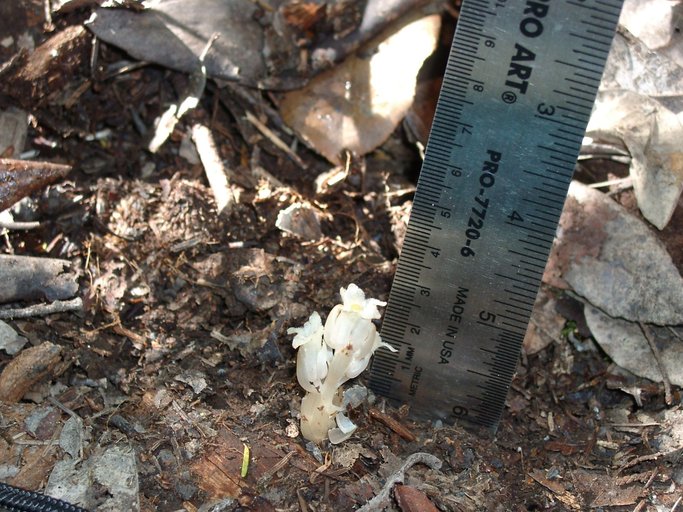
Pityopus californica is a perennial herb (mycoparasitic) that is native to California, and also found in Oregon.

Alternate Names and Sources:
Pityopus californicusOTHER
Siskiyou Del Norte Modoc Humboldt Shasta Lassen Trinity Plumas Tehama Butte Mendocino Glenn Sierra Yuba Lake Nevada Colusa Placer Sutter El Dorado Yolo Alpine Napa Sonoma Sacramento Mono Amador Solano Calaveras Tuolumne San Joaquin Marin Contra Costa Alameda Santa Cruz Mariposa Madera San Francisco San Mateo Merced Fresno Stanislaus Santa Clara Inyo San Benito Tulare Kings Monterey San Bernardino San Luis Obispo Kern Santa Barbara Ventura Los Angeles Riverside Orange San Diego Imperial
DJJJASONAFMM

Bloom Period
The blue points on the map indicate observations in Calflora.
Click on the map to view observations within a specific county.


Accepted by: PLANTS
Jepson eFlora section:
eudicot
USDA PLANTS group:
Dicot

North Coastal Coniferous Forest, Yellow Pine Forest, Red Fir Forest, Mixed Evergreen Forest

[fs.usda.gov] Description, Odor, Habitat: Pityopus californicus (Pityopus – Pine foot from it's habitat) is the smallest of the mycotrophic wildflowers in the Heath family. It ranges in height from 1to 10 centimeters. The entire plant is a pale creamy white. The leaves are crowded and scale-like on the flower stalk (peduncle). The inflorescence is a raceme of 2 to 11 flowers at the tip of the stem. Upon emerging from the ground, the flowers are pendant. As the anthers and stigma mature, the flowers are spreading to all most perpendicular to the stem. In 1950, noted California botanist, J.T. Howell noted that the odor of the mature plants resembled over-ripe Brie cheese and would be attractive to some animals. The fruit is a capsule. As the capsule matures, the flowers become erect. Once ripened, seed is released through slits that open from the tip to the base of the capsules. The plant is not persistent after seed dispersal. Pityopus californicus flowers from early summer to mid autumn. It is found in mature, moist, shaded, mixed or coniferous forests up to 1,800 meters in elevation. (link added by Mary Ann Machi)

Suggested Citation
“Calflora - Taxon Report.” The Calflora Database, a non-profit organization. .

Accessed:
My Calflora My Observations Add Observations Phone Applications Donate to Calflora HOME About Calflora NEWS Search for Plants Observation Search What Grows Here? Planting Guide NRCS eVegGuide Weed Manager Contact Calflora