2011 John Doyen 2011 John Doyen 2011 John Doyen 2011 John Doyen 2011 John Doyen 2003 Norman Jensen 2008 Keir Morse 2015 John Doyen
Lewisia oppositifolia is a perennial herb that is native to California, and also found in Oregon.
California Rare Plant Rank: 2B.2 (rare, threatened, or endangered in CA; common elsewhere).
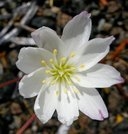
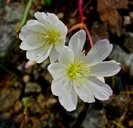
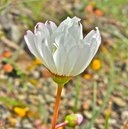
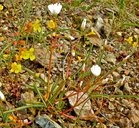
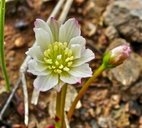
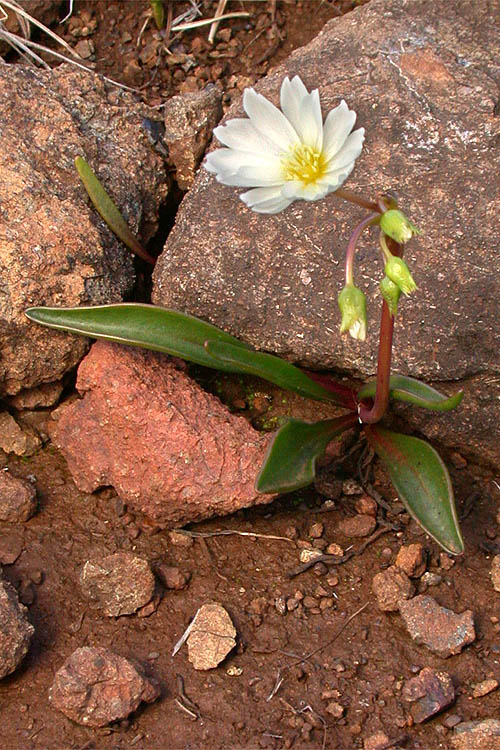
[Wikipedia] Rarity, Description, Threats: Lewisia oppositifolia is a rare species of flowering plant in the family Montiaceae known by the common name opposite-leaf lewisia. It is native to the Klamath Mountains of Josephine County, Oregon, and Del Norte County, California, where it is a local serpentine endemic generally found in moist areas. This is a perennial herb growing from a small taproot and caudex unit. It produces a basal rosette of several lance-shaped, blunt-tipped fleshy leaves up to 11 centimeters long. There are sometimes smaller leaves located on the lower stem. The inflorescence is made up of one or more erect stems up to about 20 centimeters long, each bearing 1 to 6 flowers. The flower has 8 to 11 white to pale pink petals with blunt or jagged tips, each between 1 and 2 centimeters long. At the center are several stamens with pale anthers. This plant has a limited distribution and it is threatened by human activity in the area, such as logging. (link added by Mary Ann Machi)
/app/up/entry/476/th/143022.jpg:!/app/up/entry/476/th/143020.jpg:!/app/up/entry/476/th/143025.jpg:!/app/up/entry/476/th/143021.jpg:!/app/up/entry/476/th/143024.jpg:!0000 0000 0803 0297:!0000 0000 0208 0737:!0000 0000 1115 2607:!
2011 John Doyen:!2011 John Doyen:!2011 John Doyen:!2011 John Doyen:!2011 John Doyen:!2003 Norman Jensen:!2008 Keir Morse:!2015 John Doyen:!
mu26667:!mu26665:!mu26669:!mu26666:!mu26668:!null:!null:!null:!
Suggested Citation
Calflora:
Information on California plants for education, research and conservation,
with data contributed by
public and private institutions and individuals.
[web application]. 2024. Berkeley, California:The Calflora Database
[a non-profit organization].Available:
https://www.calflora.org/(Accessed: 07/26/2024).



 one or more occurrences