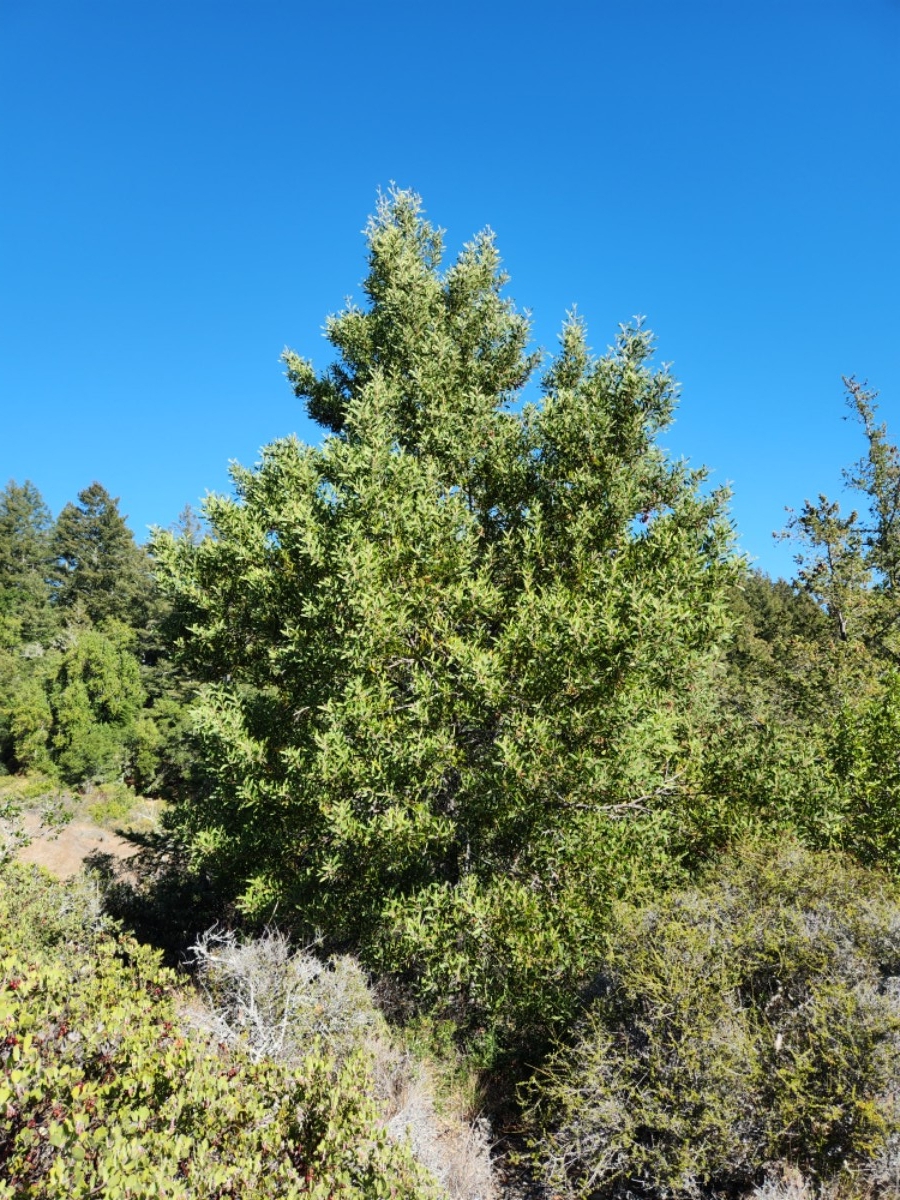
Calflora Taxon Report
Acacia melanoxylon R. Br.
Blackwood acacia
Acacia melanoxylon is a tree that is not native to California.
Cal-IPC rating: limited

Alternate Names and Sources:
None
Siskiyou Del Norte Modoc Humboldt Shasta Lassen Trinity Plumas Tehama Butte Mendocino Glenn Sierra Yuba Lake Nevada Colusa Placer Sutter El Dorado Yolo Alpine Napa Sonoma Sacramento Mono Amador Solano Calaveras Tuolumne San Joaquin Marin Contra Costa Alameda Santa Cruz Mariposa Madera San Francisco San Mateo Merced Fresno Stanislaus Santa Clara Inyo San Benito Tulare Kings Monterey San Bernardino San Luis Obispo Kern Santa Barbara Ventura Los Angeles Riverside Orange San Diego Imperial
DJJJASONAFMM

Bloom Period
redone or more occurrences
within a 7.5-minute quadrangle
The blue points on the map indicate observations in Calflora.
Click on the map to view observations within a specific county.


Accepted by: JEPS + PLANTS + POWO + POWO
Jepson eFlora section:
eudicot
USDA PLANTS group:
Dicot

escaped cultivar

[Wikipedia] Australia native: Acacia melanoxylon, commonly known as the Australian blackwood, is an Acacia species native in South eastern Australia. The species is also known as blackwood, hickory, mudgerabah, Tasmanian blackwood, or blackwood acacia. (link added by Mary Ann Machi)

[Cal-IPC] Invasive: Acacia melanoxylon (black Acacia) is a tree (family Fabaceae) found along the coast of California, in the North and South Coast Ranges, and the San Francisco Bay region. It favors disturbed areas, and is often found near buildings and agricultural sites. Black Acacia, which has spherical cream-colored flowers, was introduced as a landscape ornamental and has escaped cultivation in some areas. Black Acacia trees can develop root suckers that grow to become large clonal populations. The trees also reproduce using seeds that are dispersed by water movement and human activities. To control mature trees, most root fragments must be removed to prevent resprouting. (link added by Mary Ann Machi)

Suggested Citation
“Calflora - Taxon Report.” The Calflora Database, a non-profit organization. .

Accessed:
My Calflora My Observations Add Observations Phone Applications Donate to Calflora HOME About Calflora NEWS Search for Plants Observation Search What Grows Here? Planting Guide NRCS eVegGuide Weed Manager Contact Calflora