
Calflora Taxon Report
Toxicoscordion venenosum (S. Watson) Rydb. var. venenosum
Meadow deathcamas
Toxicoscordion venenosum var. venenosum is a perennial herb that is native to California, and also found elsewhere in western North America.

Synonyms  
Zigadenus venenosus var. venenosusJEPS
Siskiyou Del Norte Modoc Humboldt Shasta Lassen Trinity Plumas Tehama Butte Mendocino Glenn Sierra Yuba Lake Nevada Colusa Placer Sutter El Dorado Yolo Alpine Napa Sonoma Sacramento Mono Amador Solano Calaveras Tuolumne San Joaquin Marin Contra Costa Alameda Santa Cruz Mariposa Madera San Francisco San Mateo Merced Fresno Stanislaus Santa Clara Inyo San Benito Tulare Kings Monterey San Bernardino San Luis Obispo Kern Santa Barbara Ventura Los Angeles Riverside Orange San Diego Imperial
DJJJASONAFMM

Bloom Period
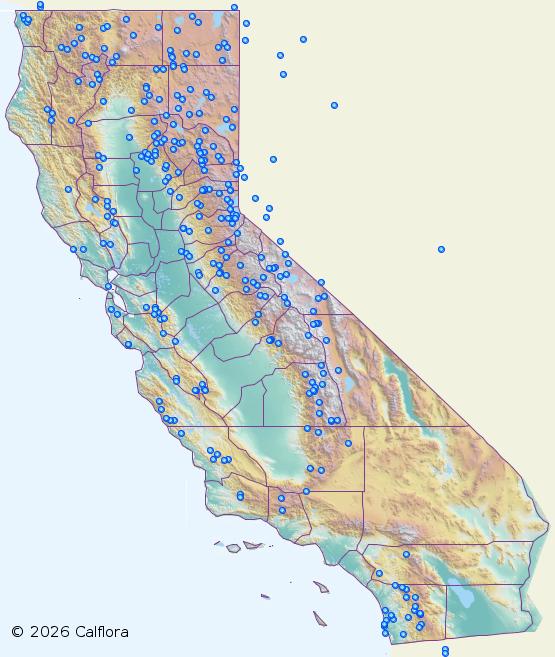
The blue points on the map indicate observations in Calflora.
Click on the map to view observations within a specific county.


Accepted by: JEPS + POWO
Jepson eFlora section:
monocot

Do not eat any part of this plant.
Occurs usually in non wetlands, occasionally in wetlands
Northern Coastal Scrub, Coastal Sage Scrub, Redwood Forest, Yellow Pine Forest, Red Fir Forest, Mixed Evergreen Forest, Foothill Woodland, Chaparral, Valley Grassland, wetland-riparian

[Wikipedia] Toxicity: Toxicoscordion venenosum has a well deserved poisonous reputation.[20] The main toxic alkaloid contained in the plants is zygacine, but other esters of zygadenine develop in the plant as the seed pods ripen.[30] While they are not easily confused with other species while in bloom they can easily be mistaken for edible bulbs like those of the camas lily in the Pacific Northwest once the leaves and flowering stems have faded.[20] As few as two bulbs are sufficient to kill a fully-grown human, with the poisons not degraded by cooking.[25] The toxins also remain stable when dried and stored, with bulbs remaining toxic for two decades after collection.[31] The seeds and the bulbs are the most toxic parts of the plants. (link added by Mary Ann Machi)

Suggested Citation
“Calflora - Taxon Report.” The Calflora Database, a non-profit organization. .

Accessed:
My Calflora My Observations Add Observations Phone Applications Donate to Calflora HOME About Calflora NEWS Search for Plants Observation Search What Grows Here? Planting Guide NRCS eVegGuide Weed Manager Contact Calflora